

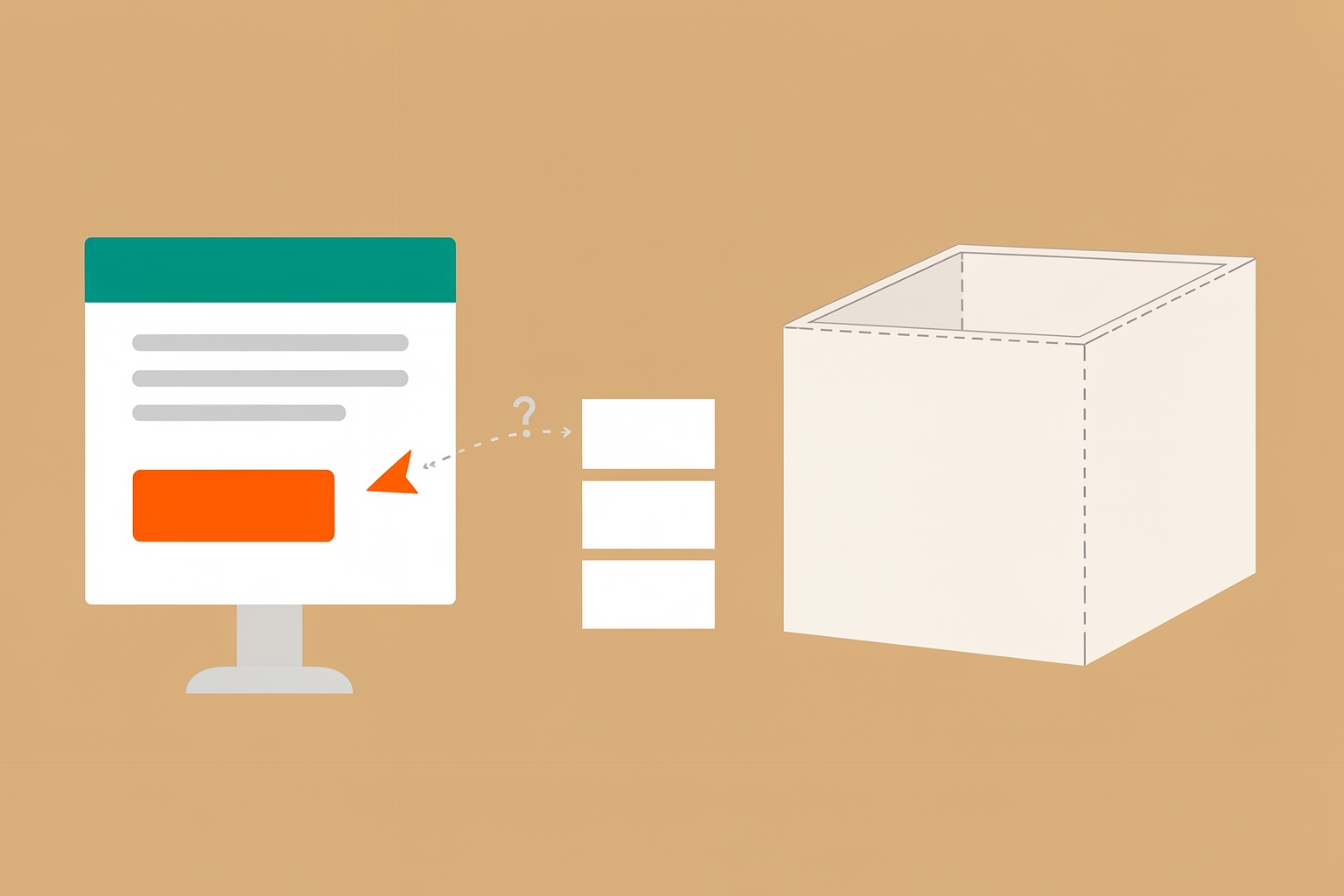
What a landing page before the product is for
You have an idea.
You have not built anything yet.
The question keeps coming up: should you put up a landing page first, or is that just a way to procrastinate on the real work?
The honest answer is that a landing page can be a cheap, useful demand test, but only if you treat the signups it produces as a signal to interpret, not a verdict to celebrate.
This guide walks through what a pre-product landing page can actually prove, what it cannot, and how to run one so the results mean something.
A pre-product landing page is a single page that explains what you plan to offer and asks for one small action, usually joining an early access list.
Stripe's startup guide describes exactly this approach: you do not need a full website yet, just a clean page explaining your offer.
Add a call to action like signing up for early access, so you can start building an email list.
The point is not the page itself.
The point is the information it generates before you spend months building.
A landing page lets you test whether anyone cares about the problem and the promise, at a fraction of the cost of building the product first.
What a signup test can actually prove
When someone gives you their email address for a product that does not exist yet, they are telling you something real.
Here is what that signal can support.
- Interest in the promise. People who read your description of the problem and solution, and still signed up, found the framing compelling enough to trade their attention for it.
- Message resonance. If you test different headlines or descriptions, differences in signup behavior tell you which framing connects. That is useful copy research you would otherwise do after launch.
- A starting audience. An early access list gives you a group of people to talk to when you do build, which Stripe highlights as one of the practical benefits of capturing interest early. Stripe
- Evidence of effort. If you drove traffic with a small paid campaign, click and signup behavior tells you whether strangers, not just friends, respond to the idea.
That last distinction matters.
Signups from your own social circle prove very little about the market.
Signups from strangers who clicked a targeted ad, or found you through a community where you participate genuinely, are a much stronger signal.
Stripe's guide suggests running a small, targeted ad campaign to see who clicks. Stripe
A tiny budget can tell you whether people are interested enough to sign up for updates.
What a signup list does not prove
This is where founders most often over-read the results.
A waitlist is a statement of mild intent, not a commitment to pay.
- It does not prove willingness to pay. Joining a free list costs a person almost nothing. Many people who sign up for early access will never open your first email, let alone buy.
- It does not prove the product will work. People signed up for the promise in your headline. Whether your solution actually solves the problem is a separate question that only real usage can answer.
- It does not prove the audience is the right one. A page can attract curious browsers who like the idea in the abstract but are not the people who feel the problem acutely. Stripe's guide makes this point about early adopters generally: not everyone will be your customer right away, so focus on the ones who really need what you are building. Stripe
- It does not prove demand will persist. Interest at the moment of signup is not the same as interest a long time later, especially if building takes longer than expected.
So the honest framing is this: a landing page test can rule out total indifference, and it can give you leads and language to work with.
It cannot, by itself, validate a business.
How to run a landing page test that means something
If you decide to build the page first, a few choices determine whether the results are worth acting on.
Write the page around one clear promise
State the problem you are solving and what makes your approach different.
Stripe's marketing guidance starts here too: define what makes your product unique, why people should care, and who needs it.
If you cannot write that sentence clearly, that difficulty is itself useful information about how well-formed the idea is.
Make the call to action specific
A vague 'learn more' button collects clicks from people who were only mildly curious.
A specific ask, like signing up for early access, filters for people willing to be contacted about the product.
Stripe recommends exactly this kind of call to action to start building an email list. Stripe
Decide where your traffic comes from before you launch
A page with no visitors proves nothing.
Plan the source in advance: a small targeted ad campaign, communities where you already participate, or people in your niche you contact personally.
Stripe suggests engaging meaningfully in online communities rather than self-promoting immediately.
Reach out to bloggers or creators in your niche with an authentic, personal offer of early access.
Whichever route you pick, know in advance what a good result looks like for that channel.
Raw signup counts are only meaningful relative to how many relevant people actually saw the page.
Interpret results against the traffic source
The same signup count means different things depending on where visitors came from.
A list built from a broad ad campaign may be large but loosely qualified.
A list built from a niche community may be small but full of people who feel the problem.
Neither is automatically better; they answer different questions.
Write down what you expected before you look at the numbers, so you are interpreting results rather than rationalizing them.
Plan what happens after someone signs up
The list is only valuable if you use it.
Stripe's guide emphasizes staying connected with first users, keeping them informed, and making them feel part of the journey.
Engaged early users are more likely to stick around and spread the word.
If you have no plan for the signups, you are collecting emails, not evidence.
When a landing page first makes sense, and when it does not
A pre-product landing page tends to work well in these situations:
- You can describe the value clearly without the product existing.
- You have a plausible, low-cost way to reach the target audience.
- You want to gather an early audience and test messaging before committing to a build.
- Your audience is comfortable with the idea of early access products.
It tends to work poorly when:
- The value is hard to explain without a demonstration, so the page undersells the idea.
- You have no realistic channel to reach the audience, so the page will sit unvisited.
- You would use a weak result as an excuse to abandon the idea without investigating why it failed, such as targeting, copy, or actual demand.
That last point deserves emphasis.
If the page gets little interest, that is not automatically proof the idea is bad.
It could be the headline, the audience you reached, or the channel.
Treat a weak result as a hypothesis to investigate, not a verdict.
Common mistakes that make the test useless
Beyond the fit questions above, a few habits quietly ruin the signal a landing page produces.
- Building the page instead of talking to anyone. A page is one input. Conversations with people who have the problem remain the fastest way to understand it.
- Counting signups as pre-orders. Unless people paid something, the list measures interest, not commitment.
- Driving untargeted traffic. Signups from people who were never candidates make the list look successful and useless at the same time.
- Letting the list go cold. If you wait a long time before following up, much of the initial interest will have faded by the time you write again.
A simple checklist before you publish the page
- Can you state the problem and the promise in one or two plain sentences?
- Do you know who your early adopters are, and where they already spend time online?
- Do you have a specific call to action, such as early access signup?
- Do you have a traffic plan, whether a small ad budget, communities, or direct outreach?
- Have you written down what result would encourage you to keep going, and what result would prompt you to investigate further?
- Do you have a follow-up plan for the people who sign up?
If you can answer yes to most of these, a landing page is a reasonable, low-cost next step.
If not, the gaps in the checklist tell you what to work on first.
Where a landing page fits in the bigger validation picture
Think of the landing page as one instrument in a larger validation toolkit, not the whole toolkit.
It pairs well with direct conversations, community participation, and content that attracts people searching for the problem you solve.
Stripe's guide also suggests starting content and basic SEO early, since search traffic takes time to build.
Share behind-the-scenes updates so people can watch the process and get invested.
If you are still weighing whether to share your work openly while you validate, it helps to understand the tradeoffs of building in public.
Visibility and validation often interact.
And if you are comparing multiple ideas before committing, a structured way to choose the best idea before you build can keep the landing page test in perspective.
Related reading that answers the next questions founders usually ask:
- Build in Public Before Finding a Co-Founder? How to Decide covers whether open sharing helps or hurts early validation.
- How to Choose the Best Idea Before You Build helps you compare candidates before testing any of them with a page.
The bottom line
Yes, building a landing page before your product can be worth it, as long as you treat it as a demand test with defined expectations rather than a validation trophy.
Keep the page simple, state one clear promise, drive traffic from a source you can interpret, and follow up with the people who sign up.
The signups will not prove your product will succeed, but they can prove strangers find your promise worth their attention.
That is a genuinely useful thing to know before you build.
Take the next step with Ideoreto. Use the ideas in this guide as a starting point for your next project.
Register for Ideoreto to get started.